
The query comparison graphs for the last iteration of the L2 Si trie:


The query comparison graphs for the last iteration of the L2 Si trie:
My previously introduced string associative table, the L2 library Si map, was leaving much of the problem space unaddressed. In particular, it was not providing a suiting coding for the internal regions of the string trie (or digital tree if you much prefer) of low node fanout. Those regions were covered by nodes of a coding better suited for mid to high fanout. The algorithmic/modelling deficiency was not for lack of problem recognition, but due to the difficulty of designing a solution that aims for both completeness and optimality. I haven’t managed to make much progress with designing such a solution, but to improve on performance I have decided to nonetheless do something, as I figured anything would be better than nothing.
The new L2 Si features two new types of nodes, one that selects a continuation with two or three bytes (and is thus better suited for low fanout parts of the trie) and a bitmapped one, that bridges the characteristics of existing mid to high fanout nodes.
The insertion is sped up across the board on the selected data sets, with the multi bytes selection nodes accounting for most of it where the keys are long, and the bitmapped nodes having a contribution for short keys (and consequently dense) data sets.


The memory usage stays largely the same.


In my previous post (String Associative Tables) I have compared for insertion time and memory usage three string tables: the unsorted hash table std::unordered and the sorted JudySL and my own L2/SI.
None of the three is the absolute best in their own class. std::unordered is not the fastest nor the most memory conservative hash table around. JudySL is based on JudyL, an integer integer map on which several guys worked a few good years. However, JudySL does not matches JudyL in effort and design complexity. It is in fact more of a nifty trick than a true string collection design. L2/SI is itself only a half baked idea. Nonetheless, I do think that such a comparison is useful and instructive enough to reveal the strength and weaknesses of the two choices: hash table vs tree.
The conclusions were that the hash table, offering half the functions of the sorted arrays (no predecessor/successor resolution, no in order traversal, etc), is the faster option, but at a significant space cost.
What was left out was the query comparison. I’ll do that now, for the same four data sets.
The first, an EN Wiki article titles set:

The second, a collection of English like made up words:

The third, a collection of binary 8 bytes long strings:

Not surprising, the hash table speed changes little between the three sets. It also matches closely the speed of insertion, outside table resizing. The tree structures do improve on their insertion times. Their performance is also sensitive to data, and the shorter the strings, the faster the queries.
The final comparison is for a set of long local file paths:

A clear win for the hash table at large set sizes, though it’s worth remembering that the trees take lot less memory to store the set (up to 5 times less).
String collections, in particular, string associative arrays, are widely used and much talked about. Yet, the real options for high capacity, high performance data structures are few, and that’s despite a huge amount of literature (and code) dedicated to the issue.
To boot, we’ll recognize two classes of string associative arrays: fully organized and half organized. The former are (ordinarily) sorted and can answer such questions as what is the predecessor/successor, what are the bounding values, etc. The latter cannot.
Hash tables are the prominent members of the half organized class. They can insert/query/remove in constant time and they are fast. There are plenty of hash table implementation around, and many of them claim to be very fast if not the fastest.
The problems with the hash tables are legion, though. Apart from what derives from their only half organized nature, hash tables have performance issues and they are badly suited for strings. Hash tables are not able to exploit the high redundancy in string collections, they don’t remove common prefix, they don’t “compress” data.
The tree based string collections have all what the hash tables miss: good worst case performance for all point operations, fully organized data, etc. They don’t have the speed, though.
Today, I’ll compare three string collections. The first is written by yours truly. It is a trie based associative table. It has the ability to organize data in several ways, and it selects the local organization based on data characteristics. It is present in the L2 library as the SI Adaptative Radix Tree Associative Array.
The second is very much the same in its basic description: trie based and adaptative. It is the better known JudySL array.
I’m mostly interested in fully organized collection, but I will include for reference the std::unordered_map. It is not the fastest nor the most memory tight hash table around, but it should serve.
One of the things with the string associative arrays is that many implementations give good performance for collections of short strings, and fail (badly) with data of a different nature. It is for this reason that I will compare the three collections for different data sets, each of its own character.
The first set is of EN Wiki article titles:

As expected, the hash table is the fastest. But not by much. And then there are the spikes, the times when the hash is resized.
The second set is of shorter entries, a collection of Dissociated Press words based on the works of Philip K. Dick.

The hash table performance stayed the same, the two tree based collections were able to improve on the shortness of data.
The third sets sees even shorter data: 8 bytes long binary strings (no 0 bytes though).

The std::unordered still renders the same performance. This time, the two trees are faster.
The last set goes the opposite way: long entries. It’s a collection of local disk paths, of an average 143 bytes length.
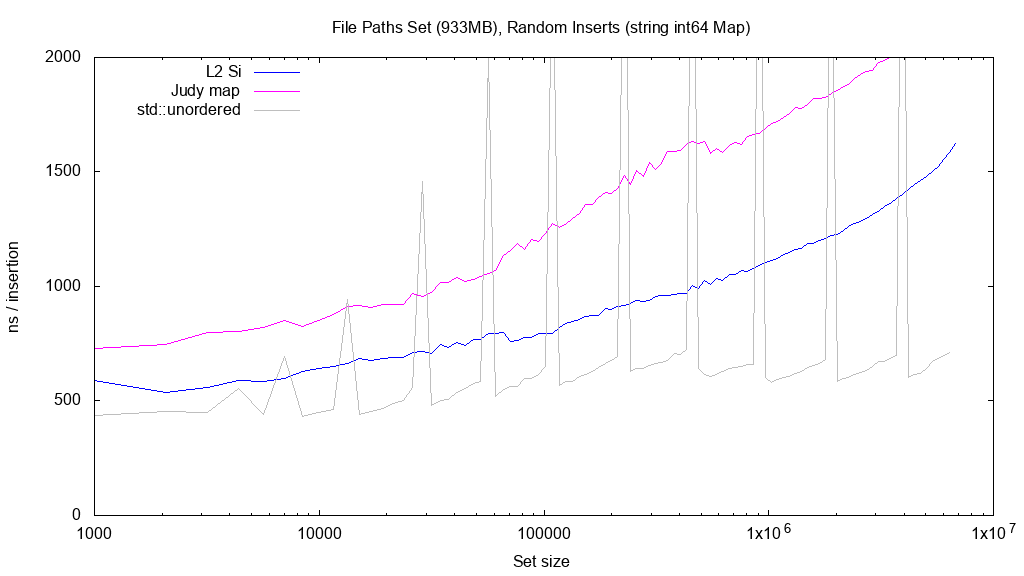
Again, the hash table performance hardly changes. The two trees perform very much as expected, i.e. slower than for the short data.
But the speed of insertion is only half the story. The other half is the memory footprint. It’s not hard to improve on speed if the memory usage is allowed to grow, that’s a basic of both hash table and trie design.
The first set, of Wiki titles, for memory:

The hash table no longer looks good. It loses badly to trees.
The Dissociated Press words set:

The 8 bytes words set:

The two sets see a somewhat lower memory usage for the hash table — the strings are shorter. But it’s still a far cry from the competition. Noting again that std::unordered is not known to be the best hash table on memory usage, the trie based collections make their gain elsewhere: they are able to strip common prefixes from strings. The longer the prefixes, the bigger the saves.
The final, local file paths set:

The trees were winners every time on memory, but this time they have actually compressed data. The average 143 bytes entry + 8 bytes of integer payload have been squeezed to less than 50. And the more strings there are, the less is the space required.
 Data Structures XXI